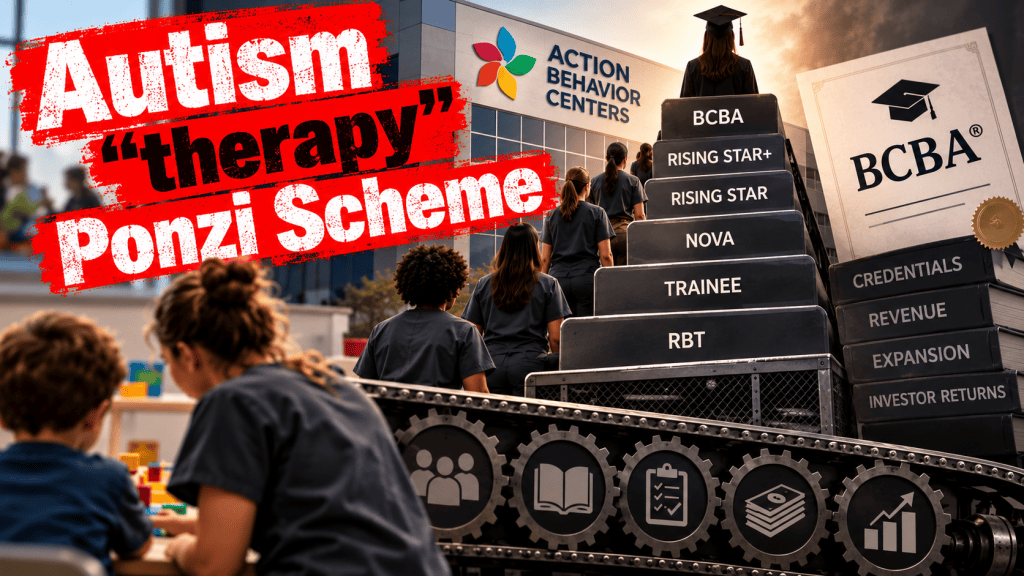
1. The Credential Factory Is Celebrating Its Own Expansion
Action Behavior Centers (ABC) announced that more than 1,000 employees have been promoted to Board Certified Behavior Analyst (BCBA) through its paid Everest Program. The company operates more than 450 centers across nine states and boasts a pipeline that pays entry-level Registered Behavior Technicians (RBTs) to obtain graduate credentials while working inside its clinics. Investors are supposed to applaud this achievement as workforce development. I see a pyramid-shaped credential factory in which autistic children supply the clinical encounters needed to keep the machinery operating.
The recruitment formula is brilliant if your objective is monetization. Hire inexperienced workers, train them while they deliver reimbursable services, provide supervised fieldwork toward higher credentials, and eventually promote them into positions that support another generation of entry-level workers. ABC even advertises a $5,000 bonus for passing the BCBA examination. The trainee is an employee, the clinic is a training facility, the supervisor validates professional advancement, and the autistic child provides the clinical setting in which the entire arrangement becomes economically viable.
ABC’s “career pathway” contains a five-stage promotion structure, which makes the recruitment incentive explicit, from entry-level therapist to trainee, Nova, Rising Star, and Rising Star+, culminating in BCBA certification. Each advancement creates opportunities for greater responsibility, compensation, and organizational expansion. A pyramid-shaped workforce structure is not proof of an illegal Ponzi scheme, but investors should examine the circular economic incentives before congratulating themselves for financing another thousand credentials. The announcement celebrates promotions, enrollment growth, and expansion without providing independently verified evidence that autistic children experienced better outcomes.
2. Anyone Can Enter the Clinic, Provided They Are Willing to Be Trained
The BACB’s RBT certification requirements permit entry with a high school education, 40 hours of compliance training, a competency assessment, and an examination. No undergraduate degree in psychology, child development, or healthcare is required. ABC advertises entry-level employment followed by RBT certification within the first 90 days, raising immediate questions about what duties employees perform before certification and how their access to children is regulated. Background and abuse registry checks are required for RBT certification, although the BACB does not universally mandate fingerprinting. Investors should demand documentation showing when checks are completed, which personnel are permitted direct contact with children before certification, and whether state-specific screening requirements are satisfied before that contact occurs.
Once inside, the worker becomes part of an extraordinary financial arrangement. According to the BACB’s own explanation of supervised fieldwork, certain hours spent delivering services as an RBT can also qualify toward BCBA supervised fieldwork requirements, provided the relevant conditions are satisfied. The employer can generate service revenue while the employee acquires professional experience, and the supervisor can oversee both service delivery and credential development when qualified to do so. The same clinical environment serves as a workplace, educational laboratory, and revenue center. Whether any particular encounter is improperly billed remains a question for claims auditors, but the potential for overlapping financial incentives is built into the arrangement.
When I applied to an ABA graduate program, I was instructed to arrange full-time clinic employment because the educational pathway was organized around concurrent clinical work. The program was marketed to me as an approximately eleven-month route through its educational component, although BCBA certification separately requires substantial supervised fieldwork and examination requirements. I recognized the economic convenience immediately. The university recruits tuition-paying students, the clinic recruits workers seeking credentials, the supervisor acquires trainees, and the student gains access to autistic children for qualifying experience. Nobody explained how the child’s independent clinical interests would be protected when so many adults had professional and financial reasons to keep the placement going.
3. Supervising the Supervisors Who Manufacture More Supervisors
The BACB’s 2026 fieldwork standards require 2,000 hours of supervised fieldwork or 1,500 hours of concentrated supervised fieldwork under the applicable pathway. At least 60 percent must consist of unrestricted activities, including assessment, program development, data analysis, and related professional tasks. Supervisors must meet eligibility requirements and complete an eight-hour supervision training, with additional oversight requirements applying to newly certified BCBAs supervising fieldwork. ABC’s announcement describes limits on trainee assignments and internal systems for tracking supervision, including remote instruction models. These are professional and administrative controls within a credentialing system that benefits from producing more credentialed professionals.
The BACB permits qualified supervisors to verify fieldwork and maintains certification requirements, documentation standards, ethics enforcement, and audit mechanisms. The problem is the reliance on professional records generated within the same employment environment that benefits from the worker’s advancement. A completed supervision form establishes a claim about training activity. It does not independently establish medical necessity, reimbursement integrity, patient consent, or therapeutic benefit. State regulators and payers may exercise additional oversight, but the BACB credential itself cannot answer whether a child should have been receiving the service in the first place.
The business logic is circular. The RBT needs supervised experience to become a BCBA, the BCBA supervises workers delivering reimbursable services, and the employer benefits when another credentialed supervisor becomes available to oversee additional staff. ABC’s Everest Program explicitly integrates paid employment, supervised fieldwork, graduate education, and promotion. The company is effectively advertising its capacity to reproduce the professional hierarchy on which its expansion depends. Investors should demand independent audits of fieldwork verification, supervision claims, conflicts of interest, treatment utilization, and the relationship between workforce growth and patient outcomes. The industry’s own certification paperwork is an inadequate substitute for independent scrutiny of the economic incentives.
4. Investors Should Divest Before the Pyramid Becomes Their Liability
The ABA industry has constructed a market in which staffing shortages become opportunities for recruitment, recruitment becomes an opportunity for credential production, and credential production becomes an argument for expanding services. ABC reported 79 percent growth in Everest participation between 2024 and 2025 and more than 1,000 BCBA promotions since the program’s launch. Those figures demonstrate that the company can reproduce its workforce. They do not demonstrate that autistic children require additional ABA hours, that the services improve quality of life, or that the company’s expansion is justified by independent evidence of clinical benefit. The promotional narrative treats the production of behavior analysts as an achievement in itself.
I founded the #banABA initiative because autistic people should not be treated as an inexhaustible source of reimbursable behavior-modification opportunities. A child can spend years receiving interventions while adults collect wages, supervision hours, graduate credentials, professional promotions, and corporate returns. Every participant in the institutional hierarchy has a measurable incentive to continue, while the child may have little meaningful authority to refuse. The possibility of reducing treatment, replacing ABA with other supports, or concluding that no behavioral intervention is necessary threatens the volume-based economics of the enterprise. A credible healthcare system should reward improved autonomy and reduced unnecessary intervention, rather than treating continuous utilization as the foundation for growth.
I am calling on private-equity firms, institutional investors, lenders, and healthcare investment committees to divest from ABA businesses that cannot independently substantiate their clinical outcomes, billing integrity, and workforce safeguards. ABC’s announcement is evidence of an expanding credential pipeline, not proof that the company has committed fraud or operates an unlawful Ponzi scheme. The financial architecture nevertheless deserves scrutiny for the very reasons its promoters celebrate it: the system recruits its own labor, generates its own supervisors, and expands its own capacity to bill for services. Investors who continue financing that expansion should be prepared to explain why credential production deserves capital when the interests of autistic children remain secondary to the corporate growth narrative. Stop financing the reproduction of the ABA pyramid. Divest, and redirect capital toward services governed by autistic people’s actual needs, choices, and consent.
Dr. Henny Kupferstein is an autistic autism researcher, policy analyst, and founder of the #banABA initiative. Misbehaviorism.com examines the financial, institutional, and scientific assumptions underlying the behavior-analysis industry.


Leave a Reply