In March 2026, Lyftingsmo and colleagues published a study in the field of Applied Behavior Analysis (ABA) claiming that a method called Errorless Compliance Training could improve “cooperative skills” in an autistic preschool child . The language sounds broad, developmental, and reassuring. The actual experiment is much narrower. The study asks whether one autistic four-year-old boy can be trained to follow adult instructions more quickly and with less resistance during daily preschool routines.
The research takes place in a Norwegian preschool where the child receives about twenty-five hours a week of one-to-one intervention. His day is organized around adult-led activities such as pointing to pictures, singing songs, putting away toys, and washing his face. Each task becomes part of a tightly structured instructional sequence where adults give directions, step in quickly if he hesitates, and reward him after successful completion.
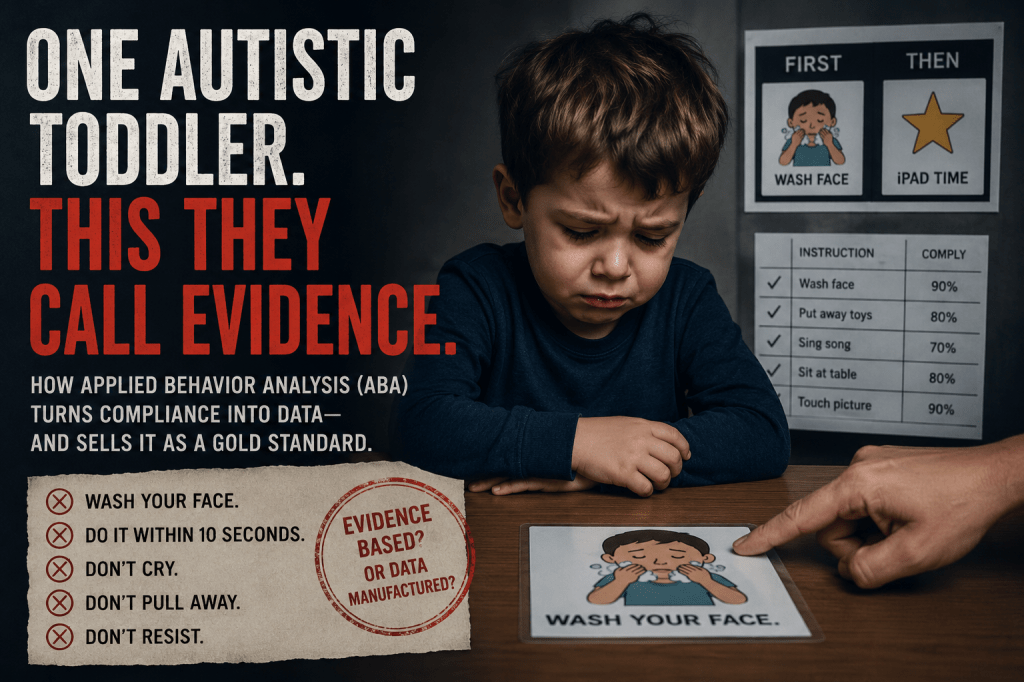
This single autistic child becomes the entire dataset. The study defines success as beginning an instruction within ten seconds, completing it correctly, and showing no resistance such as crying, refusing, or pulling away . Every response is scored as correct or incorrect and converted into percentages. Those percentages later become evidence that the method is “effective.”
How Applied Behavior Analysis (ABA) Produces Evidence
“Wash your face.”
Do it within ten seconds.
Do not cry.
Do not pull away.
Do not resist.
That is the behavioral logic underneath the study’s definition of “cooperation.” If the autistic child completes the task quickly and without visible distress, the response is coded as correct. If the child cries, delays, resists, or disengages, the response becomes incorrect . Over time, the percentages of “correct” responses rise, and those rising percentages become evidence that the intervention is effective.
This is where the claim of a “gold standard” becomes difficult to examine without slowing down and looking carefully at what is actually being measured. The study does not demonstrate that the child understands hygiene, feels safe during the interaction, develops self-regulation, or gains autonomy. It demonstrates that under a tightly controlled system of prompting and rewards, an autistic preschooler becomes more likely to comply with adult instructions without outward resistance. The measurement system treats visible distress as failure of the child’s response, not as information about the experience itself.
Applied Behavior Analysis (ABA) calls this objective evidence because the behavior can be counted, graphed, and reproduced. The numbers move upward. Compliance increases. Resistance decreases. The graph stabilizes. Within the logic of ABA, that becomes proof that the intervention works. Yet the underlying theory depends on reducing complex human experiences into observable behavioral outputs that can be shaped through reinforcement. The closer the child moves toward fast, non-resistant obedience, the stronger the intervention appears statistically.
What the Study Actually Measures
What matters for a parent is understanding what the study is truly measuring. The researchers are not measuring understanding, comfort, emotional wellbeing, independence, or communication. They are measuring how often an autistic child complies with adult instructions under a structured system of prompting and rewards.
The child’s experience is organized around constant adult direction. Adults decide the task, the timing, the prompts, the rewards, and the definition of success. If the child starts quickly, finishes the task, and does not resist, the response is marked correct. If the child hesitates, refuses, cries, disengages, or needs more time, the response becomes incorrect. The measurement system recognizes compliance. Everything else disappears into noncompliance.
The study presents these results as evidence of improved cooperation. Within the framework of Applied Behavior Analysis (ABA), the claim is technically accurate because cooperation has already been defined as rapid and non-resistant instruction-following. The design measures exactly what it trains. The intervention succeeds because the outcome has been narrowed to the behavior the system is built to produce.
Misbehaviorism Critique: THIS They Call Evidence
What makes studies like this important is not only what happens inside the preschool room. What matters is what happens afterward. A highly controlled experiment involving one autistic toddler becomes part of the scientific foundation used to justify a multibillion-dollar ABA industry. The graph survives long after the child disappears from view.
The study demonstrates that when adults systematically guide behavior, reward compliance, and reduce opportunities for refusal, an autistic child becomes more likely to comply within that structure. That finding is then elevated into evidence that Applied Behavior Analysis (ABA) improves cooperation, participation, and functioning more broadly. The jump from “this child followed more instructions” to “this treatment is evidence-based” carries enormous institutional weight.
For a parent, the central question is not whether compliance can be increased. The study clearly shows that it can. The deeper question is whether compliance should be treated as the central measure of human development in the first place. This paper calls rapid, non-resistant obedience “cooperation,” measures it in one autistic preschool child, and presents the resulting percentages as scientific evidence for a field that markets itself as the gold standard of autism intervention.
APA Citation:
Lyftingsmo, M. S., Viken, K., Sannes, E., Ottersen, K. O., Torve, B. A., & Isaksen, J. (2026). Errorless Compliance Training (ECT) in Cooperative Skills in a Preschool Child with Autism. International Electronic Journal of Elementary Education, 18(3), 455-462.


Leave a Reply