In 2024, researchers affiliated with the University of North Carolina at Charlotte and Utah State University published the Addressing the Challenging Behavior of College Students with Intellectual Disability in Inclusive Postsecondary Education Programs, in the Journal of Inclusive Postsecondary Education. They surveyed the directors of Inclusive Postsecondary Education (IPSE) about the challenging behaviors of intellectually disabled students in the college programs they direct.
On paper, a Comprehensive Transition and Postsecondary Program (CTP) is a federally approved college initiative that allows students with intellectual and developmental disabilities to access federal financial aid while focusing on employment readiness, social inclusion, and independent living skills. The CTP program directors ensure the institution collects tuition while granting students a “legal status” that assigns them the same privileges as other college students to attend the campus gym, library, or housing.
There are approximately 350+ IPSE across the United States. In this study, the researchers surveyed these 46 program directors. Their intention was to identify “challenging behaviors” in the admission process for these programs they direct. The so-called college students were not surveyed at all. This study used a Likert-scale survey that asked open-ended questions, program leaders answered questions with “always, sometimes, never, unsure, yes, no”, multi-select lists or typed responses.
Researchers aimed to map national “support gaps” through the eyes of these program leaders. The survey consisted of 36 questions that focused on three main areas:
- how programs decide which students to admit based on their past behavior
- how they plan out specific supports for those students, and
- who actually helps carry out those plans on campus.
The study categorizes various diagnostic groups, including autistic individuals with intellectual disabilities, under the label of “challenging behavior.” This grouping specifically targets those with lower IQ scores, as participants of these programs, but not as participants of this study. The survey data reveals that program directors often prioritize “risk management” and obedience over actual education. While 80% of program directors systematically deny admission for physical aggression, many also reject students for “non-compliance” or “non-participation.” This shows that colleges aren’t just looking for safety. They are looking for students who are easy to control.
One program director stated plainly: “We are an academic program not a therapeutic program.” Despite this claim, universities continue to act like clinics by using medical-style tools like behavioral reviews and surveillance systems. Even though they say they aren’t a “therapeutic” space, they still treat DD (Developmental Disabled) /ID (Intellectually Disabled) students like patients who must be monitored and managed.
When the Campus Becomes the Clinic
By framing their findings as a “national need,” the researchers aren’t actually calling for more education. They are creating a path to expand behavioral therapy into universities. This turns the “support gap” into an excuse to increase surveillance, moving the focus away from helping students grow and toward simply making sure they are easier for the institution to control.
The data they collected focuses almost entirely on how to manage and track student conduct. For many adults with intellectual disabilities, the transition to postsecondary education is often shadowed by a lifelong history of clinical labeling and behavioral monitoring. While college programs for students with disabilities promise freedom and a sense of belonging, they materially function as segregated day programs operating on college campuses.
An Autistic individual whose formative years were defined by clinical records of “challenging behaviors” must not be permanently relegated to that pathological label. Higher education should serve as a domain of autonomy and civil rights, not as a clinical extension designed for institutional control. Despite this, behaviorists now assert that behavior modification is an entitlement for the purpose of maintaining program security. More concerning is the argument that such interventions constitute a student right under the Americans with Disabilities Act (ADA). In reality, mandating that a behavior analyst shadow a student on campus is not a reasonable accommodation; it is an act of institutional surveillance and a violation of the privacy protections intended by the Family Educational Rights and Privacy Act (FERPA).
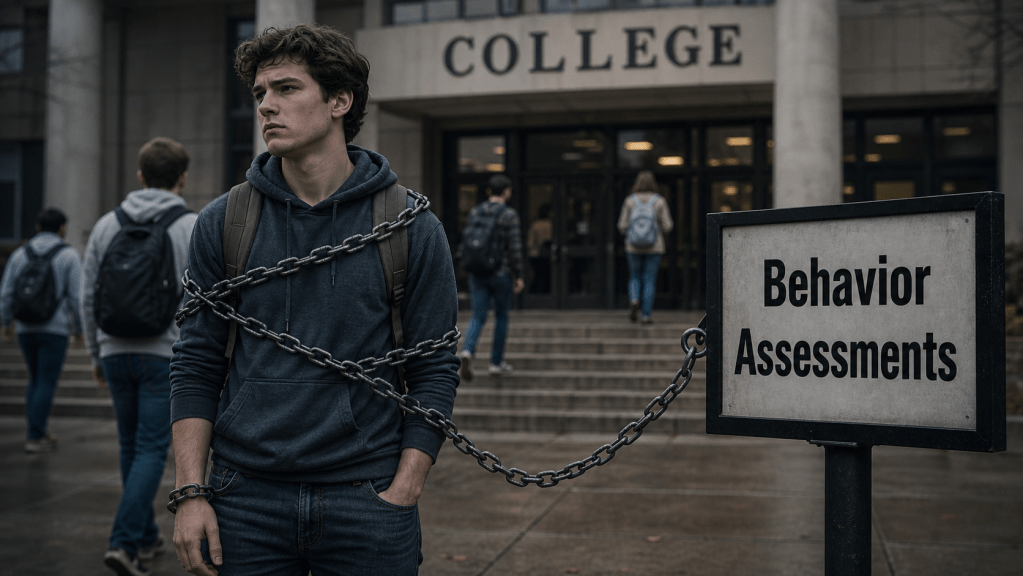
AI image depicting a college student with intellectual disability chained to a “Behavior Assessments” sign in front of a college building.
Why “Belonging” Now Requires a Permit
The transition from K-12 to college creates a systemic ‘behavioral trap’ fueled by a specific legal shift. In high school, the Individuals with Disabilities Education Act (IDEA) mandates that the school must help you. In college, the Americans with Disabilities Act (ADA) only ensures you have a ‘right to try.’ While the average student uses the ADA for a ramp or extra test time, these IPSE programs use it as a loophole to replace mandated support with conditional surveillance.
By forcing students to remain dependent on behavioral therapists who act more like compliance officers than educators, institutions ensure that inclusion remains a ‘pay-to-play’ system. Instead of treating college as a place for learning and freedom, the study suggests that students only get to ‘belong’ on campus if they are easy to manage. Ultimately, this turns inclusion into a reward for being compliant rather than a basic right, reducing adulthood to a privilege for those who follow every rule perfectly.
Since these IPSE directors focus on the money rather than the person, the student’s daily life becomes a performance of compliance. On the surface, students enjoy standard campus privileges like library and gym access while attending classes on life skills like cooking or transit. While regular students are learning to “find themselves,” these students are being taught to “hide themselves.” However, the reality behind this “inclusion” is deeply transactional.
Their social “buddies” are actually regular students paid as Direct Support Professionals through Medicaid HCBS vendors. This clinical focus changes how we see the students themselves, which changes how colleges operate. When behavior becomes the main way we judge disabled adults, we stop seeing them as people and start seeing them as problems to be solved. The authors of the study define “challenging behavior” so broadly that it can include almost anything like being quiet, refusing to join in, or feeling upset. In a college setting, these are normal human reactions, but here they are used as reasons to monitor and control students.
This focus on behavior takes away a person’s right to be an adult. Adulthood is about making your own choices, including the right to make mistakes. Yet these programs suggest that compliance is the only path to inclusion. If compliance is the opposite of adulthood, then these universities are not helping students grow up; they are training them to remain permanent subjects of institutional rule. In the end, this system treats adulthood as a privilege for those who comply, rather than a right for everyone. This is how postsecondary college experiences become an extension of the childhood entrapments of behavior modification.
The law that governs special education in grade school, was designed to ensure a “free and appropriate public education. The Individuals with Disabilities Education Act” (IDEA) was never meant to be a life sentence of supervision. However, this study suggests a different path. Instead of seeing college as a time for freedom, the authors argue that the behavioral controls used in childhood should simply follow students into their adult lives. They frame the lack of strict behavioral mandates in college as a problem to be solved, looking for new ways to keep students under the same kind of supervision they experienced as children.
To make this transition sound positive, the study uses the soft language of “supports.” In reality, nearly half of the programs surveyed use clinical methods like “behavior specialists” and “reinforcement systems” on their adult students. One respondent even described the goal of an intervention as “extinguishing” a student’s behavior. This is a term used in behavior analysis for young children. While the setting has changed from a classroom to a campus, the underlying goal remains the same: managing the person is the entitlement of the service provider, and the right to education becomes contingent on the service provider’s salary.
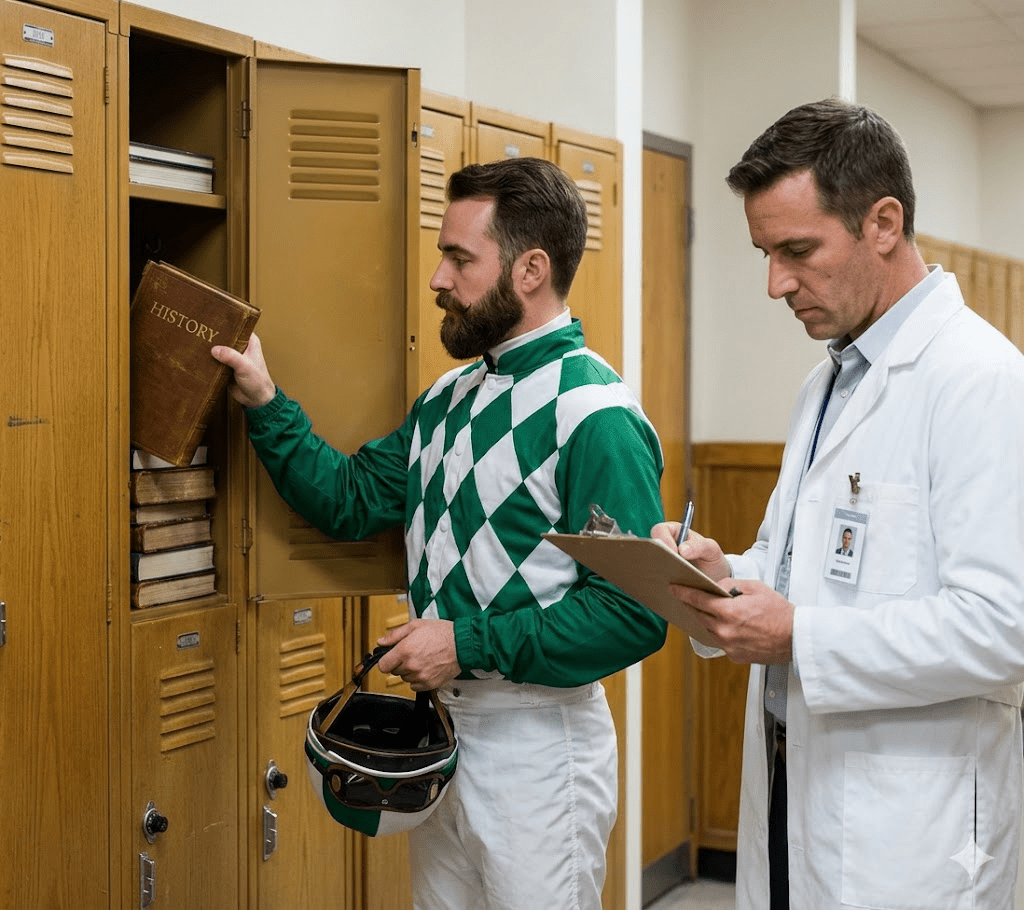
AI image depicting a closer look: Under the watch of a clinical professional, a student retrieves a history book, illustrating how the campus has turned into a monitored clinical setting.
The Expansion of Behavioral Control
The paper frames its methods as compassionate support, yet the underlying structure remains rooted in behaviorism. Personal distress and human emotions are reduced to “observable conduct,” which is then measured as a “disruption” requiring intervention. This transition is marked by the introduction of Applied Behavior Analysis (ABA) specialists into the university setting. This push is perhaps unsurprising given that two of the study’s researchers are BCBA-D practitioners.
Conflicts-of-interest are an industry standard in what behaviorism research actually shows. Their professional background suggests a clear bias: when the researchers are behavior analysts, they are more likely to view the student as a set of data points to be managed rather than an adult with an inner life. ABA, once a tool confined to pediatric clinics, is now entering higher education as a technical solution for “managing” adult students.
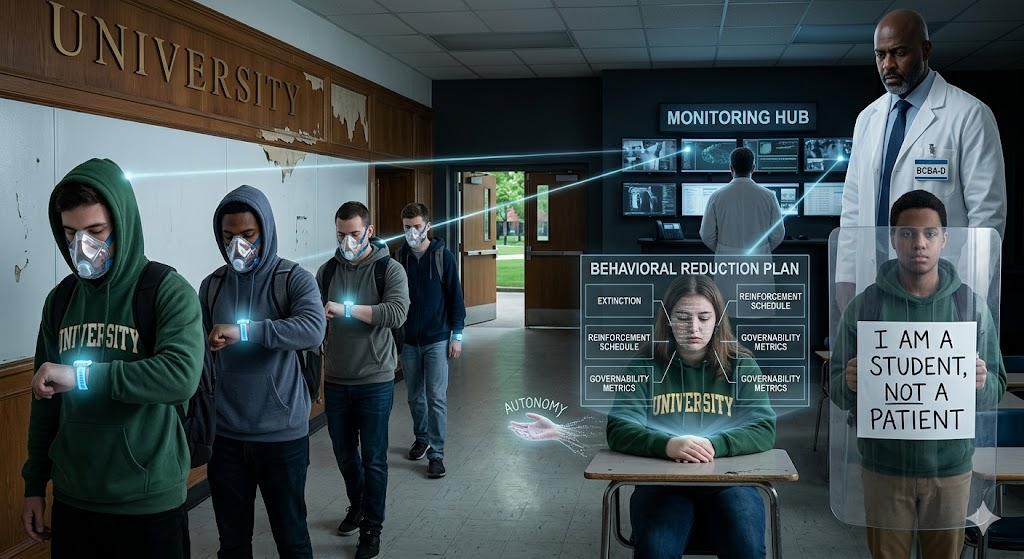
AI image showing intellectually disabled adults being monitored using behavior plans and supervision in college settings.


Leave a Reply