
misbehaviorism
For decades, assisted typing has been treated as the defendant in a disciplinary courtroom convened by behaviorism. The charge has been consistent: the typed words of nonspeaking autistic people cannot be trusted because an assistant might influence them. On that basis, entire forms of communication have been dismissed before any meaningful inquiry could occur.
This article begins by reversing that arrangement, in response to Jaswal’s study titled “Why We Need to Study Assisted Methods to Teach Typing to Nonspeaking Autistic People”. The question is not whether autistic communication is pure enough to satisfy behaviorists. The question is whether behaviorism’s own methods can justify the authority they claim. If functional behavior assessment and stimulus-control analysis are truly universal sciences of behavior, as their proponents insist, then they should be able to answer a straightforward problem: is spelling under assisted conditions communicative behavior controlled by the speller, or non-informed motor output shaped by another?

Behaviorism has long claimed exclusive jurisdiction over such questions. It asserts that behavior can be analyzed without reference to interior states, that authorship can be determined through controlling variables alone, and that coercion can be distinguished from expression through functional analysis. Those are not modest claims. They are promises of universal competence.
Yet in the very cases where these tools are most needed—where power asymmetries are obvious and the risk of coercion is real—behaviorism retreats into prohibition rather than analysis. Instead of applying its own methods, it declares the entire category inadmissible. That is not science meeting a challenge. That is misebehaviorists protecting itself from examination.
This essay therefore treats assisted typing not as a problem to be judged, but as a test case for behaviorism’s reach. If its methods are what it says they are, they should be able to meet this problem on their own terms. And if they cannot—if stimulus-control analysis and FBA cannot reliably distinguish authored expression from coercion—then the conclusion is not that autistic communication is invalid. The conclusion is that behavioral authority has overclaimed its jurisdiction.
The burden, for once, should fall where it belongs: on the framework that insists it can separate behavior from the human, even when the human speaks.
Behaviorism’s Promise
Behaviorism has never presented itself as one perspective among many. It has presented itself as the science of behavior—comprehensive, methodologically sufficient, and capable of explaining action without recourse to unobservable interior states. Its foundational promise is that behavior can be analyzed through publicly measurable variables alone, and that meaning, intention, and authorship are unnecessary constructs when controlling contingencies are properly identified.
From this framework follow several specific commitments. First, that authorship is definable through stimulus control: the true source of a response is the set of variables that reliably evoke it. Second, that coercion and communication are functionally distinguishable, because behavior shaped by another’s prompts will differ in measurable ways from behavior under the control of the individual. Third, that functional behavior assessment can isolate these variables with sufficient precision to determine what is and is not genuine expression.
These claims are not tentative. They are the basis on which behaviorism has claimed authority over classrooms, clinics, and courts. They justify the dismissal of other epistemologies as unscientific and the elevation of behavioral methods as the sole legitimate arbiters of validity.
If those commitments are real, they must be able to withstand difficult cases. A universal science does not choose easy examples and exempt the rest. It proves itself at the boundary conditions where power is unequal, bodies do not conform to normative motor patterns, and communication emerges through mediated forms.
The question, then, is not whether assisted typing conforms to behaviorist expectations. The question is whether behaviorism can fulfill its own promises when confronted with autistic expression. Can its methods, without appeal to presumption or prohibition, determine who controls the typed response? Can it separate facilitation from authorship using the tools it claims are sufficient for all behavior?
If the answer is yes, behaviorism earns the jurisdiction it demands. If the answer is no, the failure belongs to the theory, not to the communicator.
The Case That Exposes the Limits
Assisted typing is precisely the kind of problem behaviorism claims it can resolve. It involves observable responses, identifiable prompts, and measurable contingencies. If stimulus-control analysis functions as advertised, this should be an ordinary technical question: determine which variables control the selection of letters and establish authorship accordingly.
Yet decades of research have produced not resolution but stalemate. Studies designed to detect facilitator influence demonstrate that influence can occur, while other investigations suggest patterns of responding inconsistent with cue-by-cue prompting. Message-passing paradigms sometimes fail and sometimes succeed. Eye-tracking data appear to support anticipatory control by the speller, while critics argue that such findings do not eliminate subtle shaping. The literature does not converge on a decisive functional account; it converges on uncertainty.
From a behaviorist perspective, this is not supposed to happen. A method that claims to isolate controlling variables should not return an indeterminate verdict when those variables are most relevant. If stimulus control is the defining criterion of authorship, then stimulus-control analysis must be able to specify whose stimuli govern the response. Instead, the tools produce competing interpretations that cannot be resolved within their own logic.
This ambiguity is routinely treated as a defect of the communicators. Because the methods cannot deliver clarity, the communication is declared invalid. But the failure to discriminate between coercion and expression is not a moral failing of autistic people. It is a methodological stress fracture—evidence that the framework may not generalize to the very phenomena over which it asserts authority.
Assisted typing therefore functions as an edge case in the truest sense. It sits at the boundary where behaviorism must either demonstrate its universality or confront its limits. The question is not whether the speller is authentic. The question is whether behavioral tools can tell the difference at all.
Stimulus Control as a Claim to Power
Stimulus-control discourse does not operate in a vacuum. It distributes credibility. Some speakers are presumed to author their words; others are required to earn that presumption through experimental demonstration. The difference is not methodological. It is political.
In everyday life, authorship is assumed. No one demands that a speaking person prove, through controlled trials, that their sentences are not shaped by invisible prompts from companions, therapists, or institutions. Speech is treated as self-evident expression even though social influence is ubiquitous. The ordinary standard is trust.

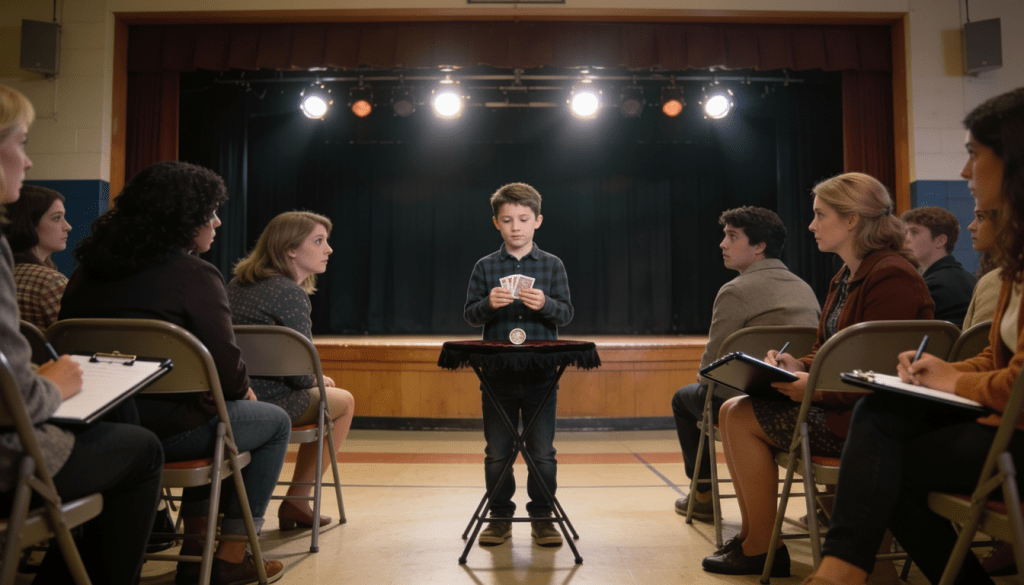
Assisted typers encounter the opposite regime. Their words are treated as suspect by default, admissible only after surviving tests designed to expose deception. This is epistemic probation: a condition in which a class of people must prove the reality of their communication before it can be heard. The burden is extraordinary, and it is imposed on those whose bodies and motor systems already diverge from normative expectations.
Stimulus-control analysis becomes the mechanism of this probation. By framing authorship solely as the product of controlling variables, behaviorism converts a social presumption into a technical hurdle. The question is no longer whether the person is communicating, but whether they can satisfy a laboratory’s definition of independence.
What does it mean for a science to require such proof from a minority body? It means that validity is not discovered but allocated. It means that the methods function less as neutral instruments and more as gatekeepers determining who is allowed to speak with authority.
This is not an accidental side effect. It is the predictable outcome of a framework that claims to separate behavior from the human while retaining the power to decide whose behavior counts as human expression.
When the Tools Fail Their Own Test
Behaviorism insists that functional behavior assessment and stimulus-control analysis can distinguish coercion from expression. That is the promise on which its authority rests. If those tools cannot perform that task in the very context where it matters most, the conclusion is not that autistic communication is defective. The conclusion is that the tools have failed their own test.
The usual response to ambiguity has been to invalidate the communicator. Because the methods do not yield a clean verdict, the typed words are declared non-communicative, the practice condemned, and the inquiry closed. This logic reverses the burden of proof. It converts methodological uncertainty into evidence against the speaker rather than evidence against the method.
A universal science does not collapse when faced with complexity. It revises its claims. If FBA cannot reliably separate authored expression from facilitator influence, then its jurisdiction must shrink accordingly. The appropriate scientific response is to acknowledge limits, not to expand prohibition.
Turning the lens back on the framework reveals how much it has overpromised. Behaviorism claimed that controlling variables could be identified without appeal to interiority, that authorship could be established through observable contingencies alone. Assisted typing exposes the fragility of those claims. The tools do not deliver the clarity they guaranteed.
The verdict, therefore, must be redirected. Ambiguity in assisted typing is not proof that autistic people cannot communicate through it. It is proof that behaviorism’s methods are insufficient as arbiters of validity. A science that cannot distinguish coercion from expression cannot claim exclusive authority to judge either.
Harms on Both Sides of the Ledger
Any honest account must hold two truths at once. Coercion and facilitator influence are real dangers. History contains documented cases in which vulnerable people were made to appear as authors of words they did not intend, with devastating personal and legal consequences. To ignore that risk would be unethical.
At the same time, enforced silence and categorical dismissal are also harms. When entire forms of communication are rejected in advance, nonspeaking autistic people are left with impoverished expressive options, their potential contributions filtered through systems that already underestimate them. The cost of prohibition is not theoretical; it is measured in years of restricted dialogue, stalled education, and lives narrated by others.
Behaviorism has treated only the first harm as scientifically legitimate. The second is framed as unfortunate but necessary collateral to protect against error. This hierarchy is not dictated by data; it is a value judgment disguised as method. A framework that recognizes only the danger of false attribution while ignoring the danger of denied authorship is not neutral—it is selective.
Ethical responsibility therefore requires living with uncertainty rather than erasing one side of the equation. The presence of risk does not justify absolute foreclosure, and the desire for access does not excuse coercion. What is needed is not prohibition masquerading as rigor, but approaches that acknowledge both dangers and refuse to resolve them through unilateral silence.
A science worthy of its name would accommodate that complexity. It would admit when its tools cannot provide definitive answers and would resist converting methodological limits into human exclusions.
Behaviorism Outside Its Lane
Behaviorism has always claimed the ability to separate behavior from the human who performs it—to treat actions as objects that can be measured, shaped, and explained without reference to interior life. That claim underwrites its jurisdiction. If behavior can be isolated in this way, then behavioral science can judge all expression on equal terms.
Assisted typing exposes the fragility of that separation. When the human speaks through mediated movement, the tidy boundary between behavior and person collapses. The methods that promised to function without interiority falter precisely where interiority becomes impossible to ignore. The science that insisted it could stand outside meaning finds itself unable to decide whether meaning is present at all.

AI Image: a team of clinicians decide whether an adult patient is using a tool correctly.
This is not evidence of scandal. It is evidence of limits. Universality has been mistaken for authority, and authority for competence. A framework that works in controlled instructional settings does not automatically earn the right to adjudicate every form of human communication. Jurisdiction must be demonstrated, not assumed.
Admitting limits would be an act of scientific honesty. Instead, behaviorism has treated limits as threats, responding with prohibition rather than humility. It is easier to declare a category inadmissible than to concede that the tools may be insufficient.
The question before the field is therefore not how to force autistic expression into behavioral lanes, but whether those lanes were drawn too narrowly to begin with.
What Misbehaviorism Demands
Misbehaviorism begins from a refusal. It refuses a world in which autistic people are placed under perpetual examination, required to prove their humanity through protocols designed without them. It refuses the idea that validity is granted only after a behavior meets the metrics of a single discipline. And it refuses the presumption that scientific authority is neutral when it consistently lands on the side of silencing those with the least power.
This perspective does not reject rigor. It rejects the monopolization of rigor by methods that cannot account for the full range of human expression. When behavioral metrics become the sole gateway to credibility, they cease to be tools and become instruments of exclusion.
A different standard is possible. Tools must justify themselves to people, not people to tools. Methods that claim to evaluate communication must demonstrate that they can do so without erasing the communicator. Frameworks that cannot distinguish coercion from expression should narrow their claims rather than widen their prohibitions.
Misbehaviorism demands that science serve the communicative lives of autistic people rather than police them. It insists that uncertainty be met with humility, not foreclosure, and that the burden of proof rest on the theories that seek to govern speech.
Conclusion — The Real Verdict
The final question is not whether assisted typing meets behaviorist standards. The final question is whether behaviorist standards can meet assisted typing. If functional behavior assessment and stimulus-control analysis cannot generalize to autistic expression, then those methods are, by definition, non-generalizable.
The judgment therefore falls where it has long been deferred. It is not communication that stands discredited, but a discipline that mistook reach for competence and prohibition for proof. A framework that cannot distinguish coercion from authorship cannot claim exclusive authority to decide either.
Humility, not new gatekeeping, is the appropriate response. Science does not advance by declaring inconvenient phenomena inadmissible; it advances by acknowledging the boundaries of its tools. When those tools fail, the ethical task is to revise the theory, not to silence the speaker.
Behaviorism has been invited to apply its own methods here, on its own terms. If it cannot do so without collapsing into contradiction, then the limits are clear. Autistic communication does not need to earn its way into legitimacy. Behavioral authority must earn the right to judge it at all.
FAQ: Terms & Context for Who Is on Trial Here?
This page explains the key ideas behind the article and how they connect to the Jaswal paper and ASHA’s prohibition.
Jaswal, V. K., Prizant, B. M., Barense, M. D., Patten, K., & Stobbe, G. (2026). Why We Need to Study Assisted Methods to Teach Typing to Nonspeaking Autistic People. Autism Research.
What is the Jaswal paper arguing?
Jaswal and colleagues argue that assisted methods to teach typing deserve study rather than categorical rejection. They note that nonspeaking autistic people have been offered limited AAC options, that earlier message-passing studies were over-interpreted, and that some individuals report learning to type independently after assisted instruction (Jaswal et al., 2026).
The paper does not declare assisted typing proven; it calls for research within existing clinical paradigms. The Misbehaviorist response accepts the need for inquiry but rejects the idea that behavioral science should be the court deciding validity.
What is Functional Behavior Assessment (FBA)?
FBA is the behaviorist method used in schools to explain actions by mapping triggers and consequences. It entered special education through IDEA and PBIS as a supposedly objective way to design behavior plans. In practice, FBA reduces communication to observable contingencies and treats meaning as irrelevant. The article asks: if FBA claims to be universal, why can it not reliably determine authorship in assisted typing? If it cannot, the limit belongs to FBA—not to the communicator.
What does “stimulus control” mean here?
Stimulus control is the rule that a response belongs to whatever variable evokes it. In the assisted-typing debate, this rule becomes a gate: if any assistant influence is possible, authorship is denied. Jaswal shows that influence can occur but does not always occur (Jaswal et al., 2026). Misbehaviorism asks a different question: can stimulus-control analysis tell the difference, or does it convert uncertainty into automatic disqualification?
Why do behaviorists call their approach the “gold standard”?
ABA claims gold-standard status because it measures compliance and change in observable behavior. Misbehaviorism has documented how this evidence is circular—outcomes are defined as success whenever behavior conforms, while distress and loss of agency are excluded. The article argues that the same “gold standard” logic is being used to police assisted typing: methods are declared invalid not because harm is shown, but because they do not fit behaviorist metrics.
Who is ASHA and why does it matter?
ASHA is the professional body whose position statements function as de facto bans on Facilitated Communication and RPM. These statements treat any assisted-typed output as inherently unreliable, discouraging research and services. Jaswal challenges that blanket dismissal (Jaswal et al., 2026). The Misbehaviorist response goes further: it argues that ASHA chose prohibition to protect disciplinary authority rather than to follow evidence.
What is “epistemic probation”?
Epistemic probation is the condition in which nonspeaking autistic people must prove authorship before being believed. Speaking people are presumed authors; assisted typers are presumed non-authors. The article argues that this burden is political, not scientific, and that stimulus-control discourse is the mechanism enforcing it.
Why talk about “jurisdiction”?
Behaviorism claims jurisdiction over all behavior, including communication. Jurisdiction means the right to judge. The Jaswal paper invites behavioral science to test its tools on assisted typing (Jaswal et al., 2026). The article accepts that invitation—and concludes that if the tools cannot distinguish coercion from expression, behaviorism has stepped outside its lane.
Isn’t facilitator influence a real risk?
Yes. Coercion and influence are genuine dangers, and Misbehaviorism does not deny them. The problem is the hierarchy that treats only this risk as scientific while ignoring the harm of enforced silence and categorical dismissal. Ethical practice requires living with uncertainty, not resolving it through permanent prohibition.
So does this article agree with Jaswal?
Partially. It agrees that categorical bans are unjustified and that inquiry is necessary. It disagrees that behavioral paradigms should be the final court of appeal. Where Jaswal asks for more research inside the existing framework, Misbehaviorism asks whether that framework has earned the right to judge at all.
What is the article’s verdict?
The verdict is on the discipline, not the communicator. If behavioral methods cannot generalize to autistic expression, those methods are non-generalizable. Autistic communication does not need to earn legitimacy; behavioral authority must earn the right to evaluate it.


Leave a Reply