January 2026 headlines making the rounds claimed that two-thirds of non-speaking autistic children gained speech with evidence-based therapy. At first glance, this sounds like a major win for early intervention and behavioral treatment.
Unfortunately, once you look past the headline, the finding tells us almost nothing about whether therapy caused those speech gains.
Let’s unpack why.
Correlation Is Doing All the Heavy Lifting Here
The central claim of the study is that two-thirds of children who were initially non-speaking later developed spoken words while enrolled in therapy. But here’s the problem:
There is no control group.
Without a comparison group of similarly situated autistic children who did not receive the intervention, we cannot determine whether speech gains were due to therapy or due to natural developmental trajectories. This is not a minor methodological oversight — it’s a fatal limitation for causal claims.
We already know that a substantial subset of autistic children acquire speech later in childhood, even after being labeled “non-speaking” early on. Estimates consistently show that roughly one-third of autistic people will not acquire functional spoken language in their lifetime, meaning that two-thirds do. That makes this study’s finding suspiciously aligned with what we already expect without intervention.
If two-thirds of children gain speech whether or not they receive therapy, then observing the same proportion during therapy proves exactly nothing.
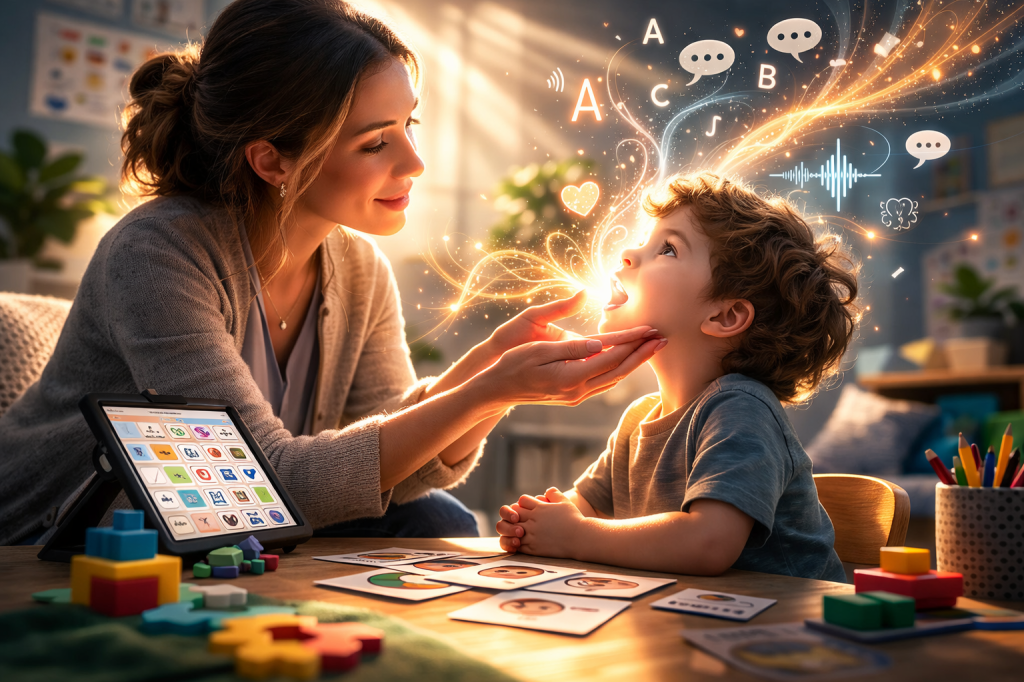
AI image depicting a speech-language pathologist gently supporting a young child during therapy, with glowing symbols of language emerging to symbolize hope, communication, and developmental possibility.
Speech Is Not the Gold Standard of Communication
Finally, the study reinforces an outdated assumption: that spoken language is the primary or superior measure of success.
Many autistic people communicate effectively without speech, using Augmentative and Alternative Communication (AAC), signing, or other modalities. Framing speech acquisition as the benchmark of progress marginalizes non-speaking autistic individuals and misrepresents what meaningful communication actually looks like.
If one-third of autistic people will never acquire spoken language, that is not a failure of intervention — it is a fact of neurodevelopmental diversity.
Natural Speech Acquisition Was Never Ruled Out
The study assumes — rather than demonstrates — that therapy is responsible for speech gains. But because it did not track an untreated comparison group, it cannot account for:
- late natural speech emergence
- maturation effects
- regression to the mean
- baseline developmental differences
In other words, the study design cannot separate treatment effects from development. This is especially problematic given that the therapies examined were not specifically designed to produce speech. If an intervention isn’t targeting speech directly, and speech outcomes still improve, that strongly suggests we may be observing developmental change rather than treatment efficacy.

AI image depicting a father introducing his twin sons to a youth football coach, with the boys at noticeably different stages of physical development—one taller and fully geared up, the other smaller and more hesitant—illustrating natural variation in growth and readiness despite shared age and background.
Baseline Ability Predicts Outcomes — Not the Therapy
One of the most telling findings is that children who did not gain speech had lower cognitive, adaptive, and motor skills at intake. That’s not surprising — but it is revealing. It suggests that pre-existing child characteristics, not the intervention, are doing most of the predictive work.
If children who are already closer to acquiring speech are the ones who eventually speak, then attributing that outcome to therapy is misleading. The intervention didn’t create the trajectory; it simply coincided with it. This isn’t evidence that therapy “worked.” It’s evidence that autistic development is heterogeneous.
“Gaining Speech” Is a Weak Outcome Measure
Another issue hiding behind the headline is how speech is defined. In this study, speech gains often meant single words or limited verbal output, not fluent, functional, or spontaneous spoken communication. A child saying a few prompted words is very different from a child using speech meaningfully, to express their needs and wants in daily life.
Reducing communication outcomes to “spoken words present or not” ignores:
- communicative intent (Did they want to be asked to say that word?)
- Generalization (Does “no” mean “no”?)
- functional use (Does “yes” indicate informed consent?)
- Alternative and Augmentative Communication (AAC) – if they are using an iPad to point to a picture that says YES in green, does that mean consent?
This framing inflates the apparent success while telling us little about real-world communication.
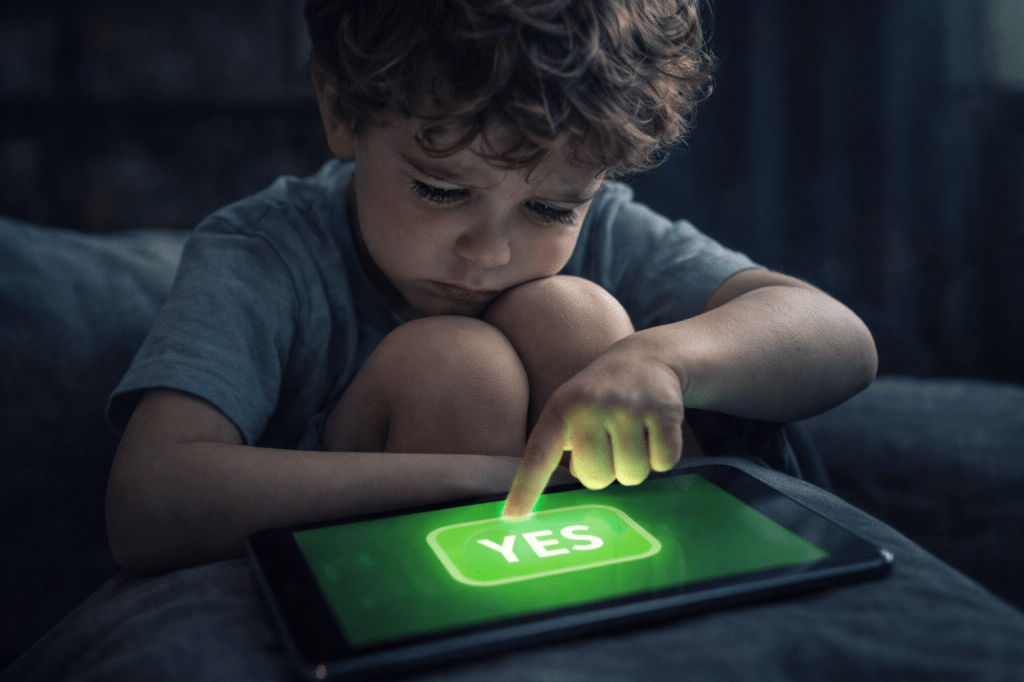
AI image depicting a withdrawn child reluctantly pressing a bright green “YES” icon on a tablet, the glowing screen contrasting with the child’s tense posture and downcast expression, suggesting compliance without enthusiasm or emotional readiness.
The Intervention Itself Was a Black Box
The children in the study received a wide variety of “evidence-based” interventions — behavioral, developmental, structured, naturalistic. Crucially, type of intervention did not predict outcomes.
If every approach leads to the same result, one of two things is true:
- All therapies are equally effective (unlikely), or
- The therapies are not the causal variable.
The authors lean toward the first explanation. The data support the second.
The Takeaway
This study does not demonstrate that early or behavioral intervention causes speech acquisition in non-speaking autistic children.
What it demonstrates is that:
- autistic language development is variable
- some children acquire speech later
- those children often do so while enrolled in therapy
That’s correlation — not causation. Presenting these findings as evidence that therapy produces speech is not just scientifically weak; it risks misleading parents, clinicians, and policymakers into believing that lack of speech reflects insufficient intervention rather than natural developmental limits.
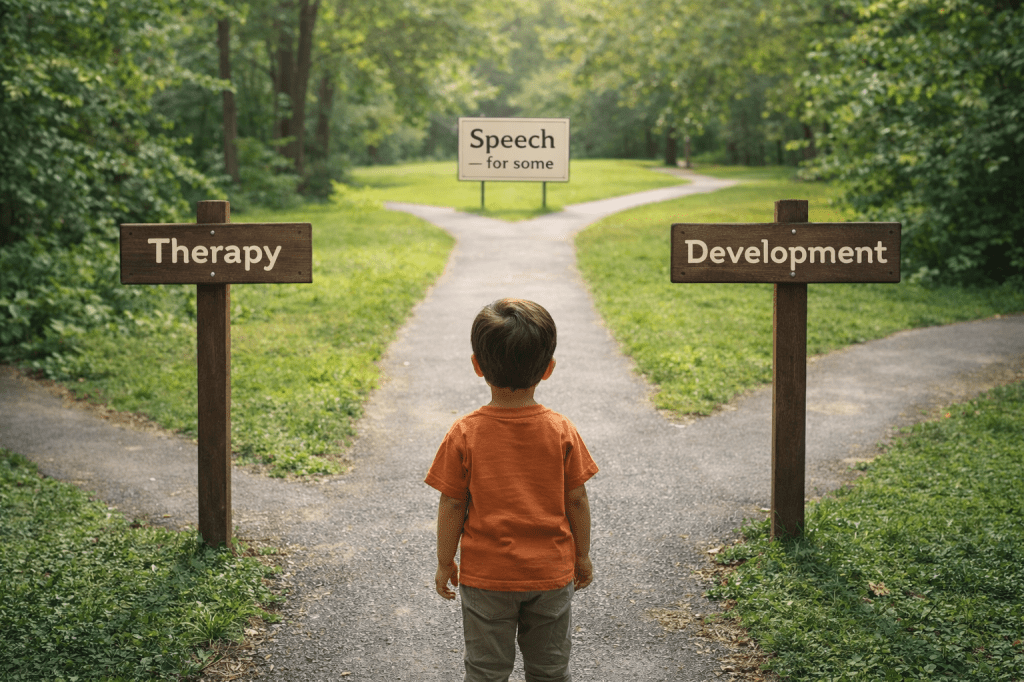
Why This Study Does Not Support ABA Efficacy Claims or Policy Mandates
What is most concerning is not merely how these findings may be interpreted, but that a scientific journal permitted them to be framed in ways that predictably invite public misrepresentation. The article’s own title, “Proportion and Profile of Autistic Children Not Acquiring Spoken Language Despite Receiving Evidence-Based Early Interventions”, is explicit and restrained, emphasizing limits rather than efficacy.
The journal article was rapidly translated into public-facing narratives that assert the opposite: that early or behavioral intervention produces speech in most non-speaking autistic children. This disconnect is not incidental. It reflects an editorial environment in which journals publish studies whose cautious scientific framing is incompatible with how their results are predictably leveraged by advocacy groups, service providers, and industry aligned media outlets, without corrective commentary or contextual guardrails.
Allowing such claims to circulate under the authority of peer-reviewed publication raises serious questions about bias and accountability in the review process. When journals fail to anticipate or address how correlational findings will be weaponized to support treatment mandates, parental pressure, or commercial interests, they become complicit in the distortion of science for policy and market ends. The credibility of clinical research depends not only on internal validity, but on whether journals take responsibility for how their approval is used to mislead the public. In this case, the divergence between the article’s stated focus on non-acquisition of speech and the celebratory public narrative of therapeutic success reflects a breakdown in that responsibility—one that merits reflection from editors, reviewers, and the field at large. Psychologists who read that study should be informed that the claims have been misappropriated to the wider public.
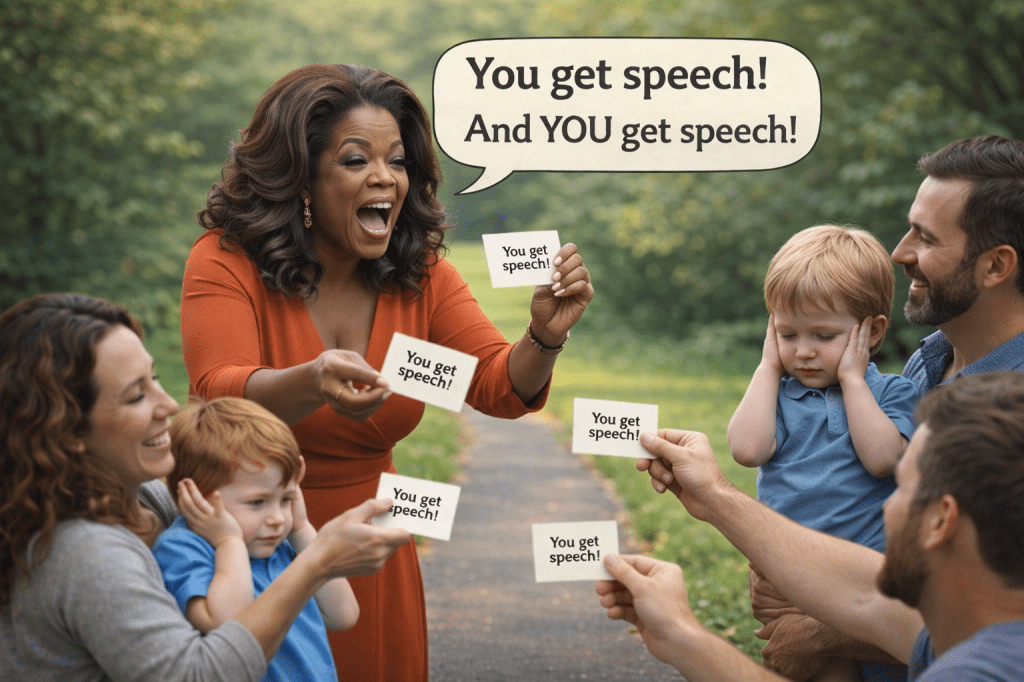
AI generated images depicting Oprah handing out coupons to children. Satirical image and caption is for advocacy and commentary purposes only, not a factual depiction of real events.
Autistic Consumer Audit of Translational Value Research
We conduct Autistic Consumer Audits because publicly funded autism research is not neutral—it shapes policy, clinical practice, insurance mandates, and the daily lives of autistic people. When NIH dollars are allocated in our name, we have a right to ask whether the research agenda reflects what autistic people actually need: communication access, healthcare equity, lifespan supports, autonomy, and quality of life. A consumer audit is not an attack on science; it is a governance check. It asks whether the stated public health purpose aligns with community priorities, whether the findings translate into actionable benefits, and whether journals and institutions allow their approval to be used in ways that mislead families or justify coercive service pathways.
In this particular study, we will unpack whether the NIH-funded aims align with what autistic people have asked for, whether the findings meaningfully change decision-making for families, and whether the public translation of the paper reflects its scientific framing. We will examine who funded it, what the grant promised to deliver, what the paper actually delivered, and how the findings are being leveraged in media and policy contexts. The central question guiding this audit is simple: does this research materially improve the lives and autonomy of autistic people—or does it primarily reinforce existing intervention narratives without clear consumer benefit?
In our prior audit of the UC Davis MIND Institute’s Angelman mouse research, we found a significant gap between the grants’ translational promises and any measurable benefit to autistic people, alongside a pattern of speculative claims linking rodent models to autism without clear consumer value. That experience shaped the criteria we bring to this review: whether publicly funded research delivers tangible, rights-affirming outcomes for autistic people—or simply extends a biomedical narrative that does not translate into lived benefit.
This study was awarded $1.15 million by the National Institutes of Health (NIH), a part of the US Department of Health and Human Services.The NIH is the nation’s medical research agency, the grant provided roughly four years of funded research support from mid-2019 through early 2023, with staged annual continuations and a documented extension of the award period to fully support the research plan (HigherGov). The original aim was to investigate “Prevalence and profile of treatment non-responders in autism early intervention.” Full, unabridged NIH grant proposals cannot be accessed via Grant ID in public databases due to confidentiality policies protecting research strategies. Instead, members of the public may access abstracts, researcher information, and funding details through NIH RePORTER, or request funded proposals directly from the investigator or via a FOIA request.
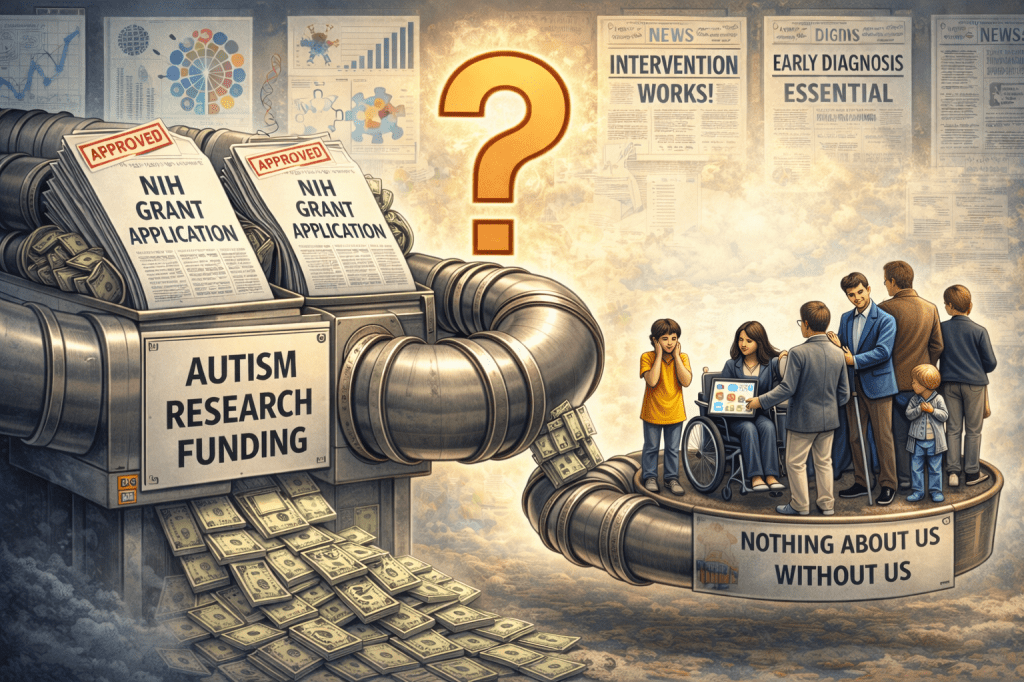
AI-generated conceptual editorial image depicting an exaggerated funding pipeline flowing from NIH autism research grants toward the question of autistic lived priorities — highlighting the tension between research investment and community-defined needs.
Who started this?
Dr. Giacomo Vivanti from Drexel University submitted a proposal to the NIH in 2019. His Curriculum Vitae (CV) claims dozens of awards for autism research listed chronologically. This is what autism researchers is expected to look like for the U.S. government, when they are awarding grants for autism research.
Vivanti claims to have a PhD in Cognitive Science from the University of Siena, Italy, and states that he completed a postdoctoral fellowship in the Autism Research Postdoctoral Training Program at the University of California Davis MIND Institute. A second conflict-of-interest that we found is that he is an associate editor of Journal of Autism and Developmental Disorders, identical to the problems we already found in the UC Davis MIND audit, as a pattern of practice. The Journal of Clinical Child & Adolescent Psychology (JCCAP) is published by the Society of Clinical Child & Adolescent Psychology (APA Division 53). One of the study’s authors, Catherine Lord, affiliated with UCLA, has served in major editorial leadership roles for JCCAP, including Editor-in-Chief, raises questions about governance transparency when authors hold editorial leadership positions within the publishing ecosystem.
Let’s start with the obvious: this is an NIH-funded project framed around identifying “treatment non-responders” in autism early intervention. That language alone tells you who the protagonist of this story is — not autistic people, but the intervention model. The research question is not “What do autistic children need?” or “How do we support communication autonomy?” It is, instead, “Which children fail to respond to our existing treatment paradigm?” The problem is located in the child, not in the intervention, not in outcome definitions, and not in the structural assumptions embedded in early intensive therapy.
For a roughly $1.5 million federal investment, taxpayers might reasonably expect a deliverable that improves quality of life, expands communication access, or protects against coercive service pathways. Instead, the central output is a profiling exercise: categorizing which autistic children do not acquire spoken language despite receiving “evidence-based” intervention. That may be interesting to intervention developers. It is far less clear how it materially changes the lived reality of autistic people. Does it expand AAC access? Does it reduce mandated hours? Does it protect families from speech-promissory narratives? There is no obvious translational product for the consumer.
There is also a subtle but important rhetorical maneuver embedded in this kind of grant framing. By studying “non-responders,” the intervention itself is implicitly validated as the gold standard. The assumption is that the therapy works — the only question is which children fail to benefit. That framing forecloses a more uncomfortable possibility: that outcome definitions are narrow, that speech is an over-privileged metric, or that the intervention model itself may not align with neurodiversity-affirming goals. In other words, the research reinforces the existing infrastructure rather than interrogating it.
From a funding priority perspective, the opportunity cost matters.
NIH autism research has historically underfunded lifespan supports, employment, housing, healthcare access, trauma, and adult quality of life. Yet millions continue to flow toward early intervention profiling and treatment optimization. The signal this sends is clear: optimizing intervention efficacy is more fundable than optimizing autistic autonomy. That is not a neutral allocation — it is a policy choice embedded in grant review culture.
Finally, there is the translational optics problem. When projects like this move from the NIH to press release to headline, the narrative often becomes: “Early intervention helps most children gain speech.” Even if the scientific framing is cautious, the ecosystem predictably converts profiling data into promotional messaging. When NIH funds projects that lend themselves to that cycle, without requiring strong consumer-centered dissemination safeguards, it effectively underwrites the amplification of intervention-first narratives.
This project may be methodologically competent, but from a consumer audit standpoint, it prioritizes treatment optimization over autistic-defined outcomes, reinforces speech-centric benchmarks, and offers unclear direct benefit to the autistic people in whose name it was funded. The question is not whether the science was executed correctly. The question is whether this is what autistic people asked federal research dollars to prioritize.
Here’s a clear timeline summary of NIH Grant R01DC017181 (Prevalence and profile of treatment non-responders in Autism Early Intervention) based on public funding records:
- Awarded: April 2019 as an NIH R01 research project grant administered by the National Institute on Deafness and Other Communication Disorders (NIDCD). (HigherGov)
- Original Project Period: April 15, 2019 to March 31, 2022. (HigherGov)
- Extension: The end date was formally extended to March 31, 2023, increasing the total award from the original ~$556 K to approximately $1.5 M over the course of the project. (HigherGov)
- Continuation Actions: During the award period, the project received annual non-competing continuation funding in 2020 (~$472 K) and 2021 (~$459 K), reflecting ongoing support to maintain work toward its aims. (taggs.hhs.gov)
- Completion: The project reached 100 % completion as of March 31, 2023. (HigherGov)
The research findings were published in the Journal of Clinical Child & Adolescent Psychology on the 20th of November, 2025, approximately two years and eight months from completion of the funding until peer-reviewed publication. It took a mere 68 days for Karina Petrova to publish the news headlines for parents on the PsyPost psychology and neuroscience news website.
The researchers’ work was supported by the National Institute on Deafness and Other Communication Disorders [R01DC017181]. Titled “Proportion and Profile of Autistic Children Not Acquiring Spoken Language Despite Receiving Evidence-Based Early Interventions. An exhaustive list of authors are as follows:
- Giacomo Vivanti, Drexel Autism Institute, Drexel University;
- Michael V. Lombardo, Laboratory for Autism and Neurodevelopmental Disorders, Center for Neuroscience and Cognitive Systems, Istituto Italiano di Tecnologia;
- Ashley Zitter, Department of Psychological and Brain Sciences, Drexel University;
- Brian Boyd, School of Education, University of North Carolina at Chapel Hill;
- Cheryl Dissanayake, Olga Tennison Autism Research Centre, School of Psychology and Public Health, La Trobe University;
- Sarah Dufek, Department of Psychiatry and Behavioral Sciences, MIND Institute, University of California Davis Health;
- Helen E. Flanagan, Provincial Preschool Autism Service, IWK Health Centre;
- Suzannah Iadarola, Department of Pediatrics, Developmental & Behavioral Pediatrics, University of Rochester Medical Center;
- Ann Kaiser, Peabody College of Education and Human Development, Vanderbilt University;
- So Hyun Kim, Center for Autism and the Developing Brain, Weill Cornell Medical College;
- Lynne Levato, School of Psychology, Korea University;
- Catherine Lord, David Geffen School of Medicine, UCLA;
- Joshua Plavnick, College of Education, Michigan State University;
- Diana L. Robins, Drexel Autism Institute, Drexel University;
- Sally J. Rogers, Department of Psychiatry and Behavioral Sciences, MIND Institute, University of California Davis Health;
- Isabel M. Smith, Department of Pediatrics, Dalhousie University;
- Tristram Smith, Department of Pediatrics, Developmental & Behavioral Pediatrics, University of Rochester Medical Center;
- Aubyn Stahmer, Department of Psychiatry and Behavioral Sciences, MIND Institute, University of California Davis Health;
- Linda Watson, School of Education, University of North Carolina at Chapel Hill
Read this study: Vivanti, G., Lombardo, M. V., Zitter, A., Boyd, B., Dissanayake, C., Dufek, S., … & Watson, L. (2025). Proportion and Profile of Autistic Children Not Acquiring Spoken Language Despite Receiving Evidence-Based Early Interventions. Journal of Clinical Child & Adolescent Psychology, 1-18.
 Misbehaviorism .com
Leave a comment